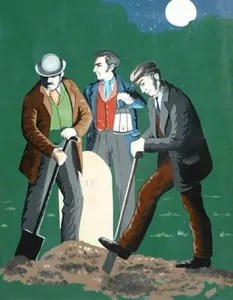
Today when someone refers to a body snatcher, it conjures up an unsavory, notorious character. Body snatchers were known to deliver corpses to students, surgeons, and teachers for dissections, and, indeed, in the eighteenth and nineteenth centuries, they developed an offensive, repugnant, and unpopular reputation. Body snatchers were rejected by every section of society from the highest echelons to the lowest criminal classes. In fact, anyone — student, teacher or surgeon — associated with dissection and corpses was considered “as abandoned and as criminal as the body-snatchers themselves, and equally destitute of the ordinary feelings of humanity.” Part of this negative attitude towards anyone associated with corpses and dissections in the 1700 and 1800s came from the fact dissection was extremely unpopular not only in England but also throughout Europe.
How body snatchers got into the body snatching business varied. One body snatcher claimed he became involved by accident. It started after he was apprenticed to a surgeon, named Mr. L—. One evening the apprentice decided to take a shortcut to the surgeon’s office through the local graveyard and over time he found the graveyard a quiet place to think. One moonless night as he sat there in quiet contemplation, he was surprised to hear voices and soon discovered three body snatchers digging up a grave. When the men struck their lantern, he was shocked to discover the surgeon Mr. L—, the local sexton, and the sexton’s assistance. Before the three men left with their freshly dug up corpse, the apprentice showed himself and was thereafter included with “profound secrecy” in the men’s nighttime raids and the surgeon’s morning dissections.
One group of body snatchers who came to prominence in the 1831 were known as the London Burkers. They stole and sold dead bodies regularly to anatomists and surgeons from St. Bartholomew’s Hospital, St. Thomas’ Hospital, and King’s College. However, some of the bodies sold by Bishop and Williams were not corpses they had stolen but people they had killed having modeled their murders on those committed by William Burke and William Hare of Edinburgh, who ended up in Madame Tussaud‘s Chamber of Horrors. With all the body snatching going on it was not long before it became common knowledge among the public about the nighttime raids committed at grave sites and the illegal things body snatchers would do to obtain a body. Those who were hired to protect the bodies were found to be no better than the body snatchers.

 ԱՐԱՔՍ ՔԱԼԻՋՅԱՆ